Common Installation Errors
While we stand by our industry-leading passive fire protection products, we caution that their effectiveness relies on proper installation. Our technical specification team spends hundreds of hours each year inspecting construction projects to ensure the installation of our cavity barriers is carried out correctly. Along the way we encounter our fair share of easily avoidable mistakes, which we of course make sure are fixed before work continues.
We asked our specialists to share the 5 most common mistakes they see in passive fire protection installations, and this is what they said.


number one
Failing to follow manufacturer’s guidance
Most installation errors arise when installers simply fail to read the manufacturer’s instructions. Passive fire products are tested to perform in specific applications and in line with regulations, so adhering to installation instructions is vital. Straying from these instructions risks undermining the fire resistance performance of the product and jeopardising the fire safety of the building at large.
Each product has unique requirements – spacing between brackets, types of fixings, and other details vary by design. Assuming that installation methods are the same across different products can lead to non-compliance and compromised fire safety performance. To ensure full compliance and maintain safety standards, every step outlined by the manufacturer must be adhered to without exception.
For this reason, Tenmat provides on-site toolbox talks to our clients, along with readily accessible datasheets, to educate contractors about the specifics of product installation. Through this early engagement errors are minimised and incorrect assumptions clarified. Site inspections and continual support ensure nothing slips through the gaps (pun intended!) – allowing projects to progress efficiently and safely.
number two
Leaving gaps between barriers or poor alignment
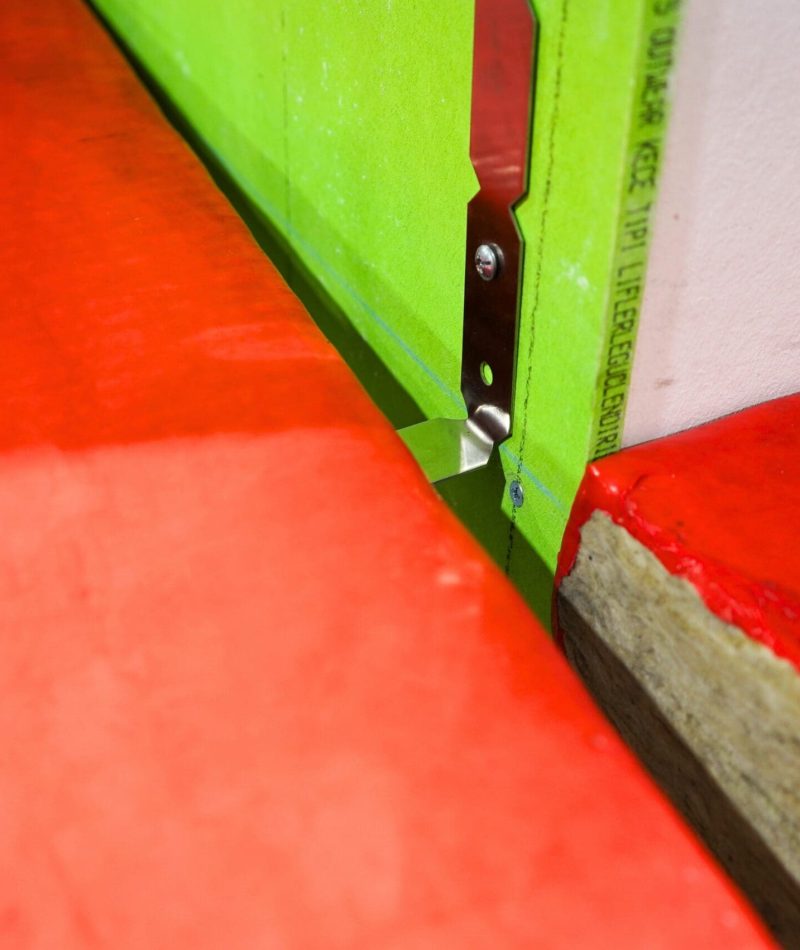
Another frequent issue our technical team encounters is the presence of small but critical gaps – either between adjoining barriers or between barriers and the surrounding substrate. These gaps often go unnoticed during the initial installation and, in some cases, can be hidden with repair tape – creating the appearance of continuity.
Even the smallest gap can compromise a cavity barrier’s ability to restrict the passage of fire. Cavity barriers are tested as continuous systems, so any break in alignment or contact undermines their integrity. Taping over gaps does not restore performance – it simply creates weak points for fire to breach.
Tenmat barriers are designed so that installers never need tape. By relying on a correctly installed, continuous product, gaps remain visible during inspection and can be quickly corrected. This transparency ensures long-term safety, prevents shortcuts on-site, and supports a compliant, robust fire protection strategy.

number three
Overusing sealant to cover installation errors
While fire-resistant sealants play an important role in sealing and finishing, our inspections sometimes reveal instances where installers rely on large amounts of sealant to compensate for incorrect cuts, oversized holes, or poorly fitted barriers. This is not what sealant is designed for, and using it as a “fix‑all” can seriously undermine fire safety.
Excessive sealant application may hide defects temporarily, but it does not replicate the performance of a correctly installed cavity barrier. In many cases, it can mask deeper issues that compromise the overall system during a fire event.
Tenmat solutions are designed to be installed with precision, reducing the need for corrective sealant altogether. When products are cut accurately and installed as specified, the finishing process becomes simple, clean, and compliant.
number four
Incorrect assumptions about air gaps
Another common misconception is the belief that intumescent materials will “travel” further than their tested limits to close larger‑than‑allowed air gaps. Every passive fire product has a maximum tested air gap, and exceeding this gap means the product may not expand sufficiently to seal the cavity during a fire.
When installers treat these maximum limits as flexible suggestions rather than strict requirements, the result is a system that may not perform when exposed to heat and flame. Intumescent expansion and air gap closure is proven in independent 3rd part testing; relying on assumptions instead of tested values jeopardises the entire fire strategy of the building.
The maximum air gaps of Tenmat solutions are clearly conveyed within all our datasheets and installation guides. These values represent the parameters under which products have been fire-tested and certified. Staying within these limits is essential for compliance and for ensuring the system does exactly what it is designed to do.


number five
Poor planning at design stage
Many installation mistakes can be traced back to issues long before any work begins on site. Oversights in project design often create scenarios where installers turn to improvisation – cutting barriers to fit around support frames, squeezing products into unsuitable spaces, or missing small but crucial areas entirely.
When passive fire protection is treated as an afterthought rather than an integral part of the building envelope, the result is inefficiency, delays, and compromised fire performance. These problems are far more difficult and costly to fix once construction is underway.
That’s why early engagement with Tenmat’s technical team is so important. Our specialists can provide design reviews, product advice, and on-site visits before work begins, helping identify potential clashes or blind spots early in the process. This proactive approach reduces the need for on-site improvisation, prevents installation errors, and supports a fully compliant fire-safe design.
Talk to our team today and enjoy the support and expertise Tenmat is renowned for.